Returning to skiing after years away: replace the old label with a current description
A remembered ability level can survive much longer than the experience it describes. When returning after a long gap, give the school a factual history instead of selecting the most flattering label from an earlier holiday. The useful outcome is suitable placement now, with room for qualified assessment and no obligation to recreate a past version of yourself.
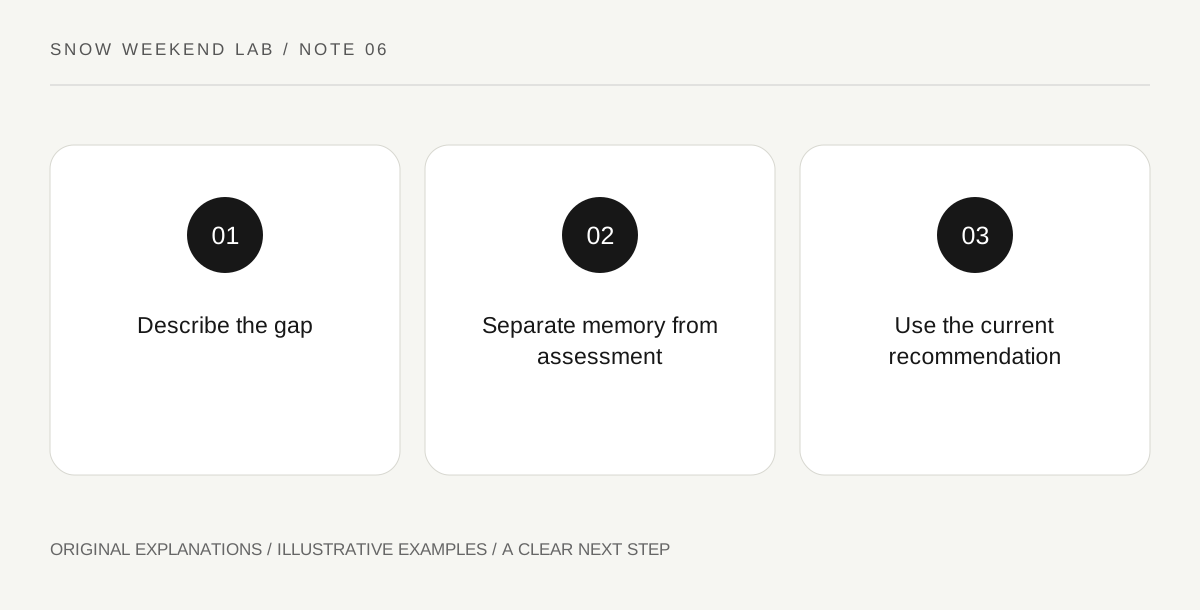
Original explanatory diagram. Read the full method and limitations below.
Put the gap into the first sentence
Whistler Blackcomb’s current lesson descriptions explicitly include people returning after many years within its first-timer description, while stating that instructors confirm placement. That illustrates why the time gap belongs in a booking conversation. Write when you last participated, in which discipline and under what kind of instruction. Do not hide the gap because you remember once completing a particular run. The provider needs the actual history, including uncertainty, rather than a level label detached from the conditions in which it was first used.
Separate memory from present evidence
Make two short columns. In the first, record remembered experience; in the second, record what has been assessed recently, if anything. A vivid memory belongs in the first until a current qualified assessment supplies information for the second. This is not a medical or fitness test. Any health concern should be discussed with an appropriate professional rather than solved by the worksheet. The simple distinction reduces the pressure to defend an old identity and makes it easier to ask for a supported return.
Keep companions out of the placement role
Friends may remember you skiing confidently and assume that the earlier routine will resume immediately. Tell them that you are following the provider’s current assessment and arrange shared time that does not depend on identical terrain. A companion’s enthusiasm is not a substitute for the school’s process. You can appreciate a group holiday while setting a separate learning arrangement. This conversation is easier before travel than at a lift queue when everyone has already imagined a particular first descent together.
Define success for the return session
Choose a goal within the provider’s role, such as a clear assessment and an agreed next step. Do not make success depend on reproducing a remembered speed, distance or trail by lunch. After the lesson, record the actual recommendation and decide the rest of the day around it. The result may be another supervised session or a shorter outing. A return is more sustainable when it provides accurate information rather than treating an old photograph as a standard the present participant must meet.
Illustrative planning example
Illustrative description: an adult writes that their last ski holiday was more than a decade ago, with several lessons but no recent assessment. They retain a remembered intermediate label as historical information rather than selecting it as a current fact. Friends arrange a base-area meeting that does not require a shared descent. The instructor’s actual placement and recommendation determine the next booking.
Questions that come up
Does once completing a difficult run establish today’s level?
No. It is a piece of history with missing context. Explain it to the provider and use current qualified assessment for present decisions.
Is beginning with reassessment a failed return?
No. A clear current understanding and appropriate next step are useful outcomes. There is no need to measure the session against a past holiday’s most ambitious moment.
References and scope
These sources support the factual background. Examples and exercises are original illustrative teaching material. References do not imply endorsement.
- Whistler Blackcomb: Ski & Snowboard Lessons — The current placement process and the explicit inclusion of long-gap returners in a lesson description; no universal level equivalence.