Ski lessons in another language: confirm understanding as a service need
A language preference on a booking form is useful only when the participant and provider understand what it means in practice. Explain which language you can follow comfortably during instruction and ask how the school handles that request. The aim is clear communication throughout the session, without treating a translation app or a bilingual companion as an automatic substitute for the agreed teaching arrangement.
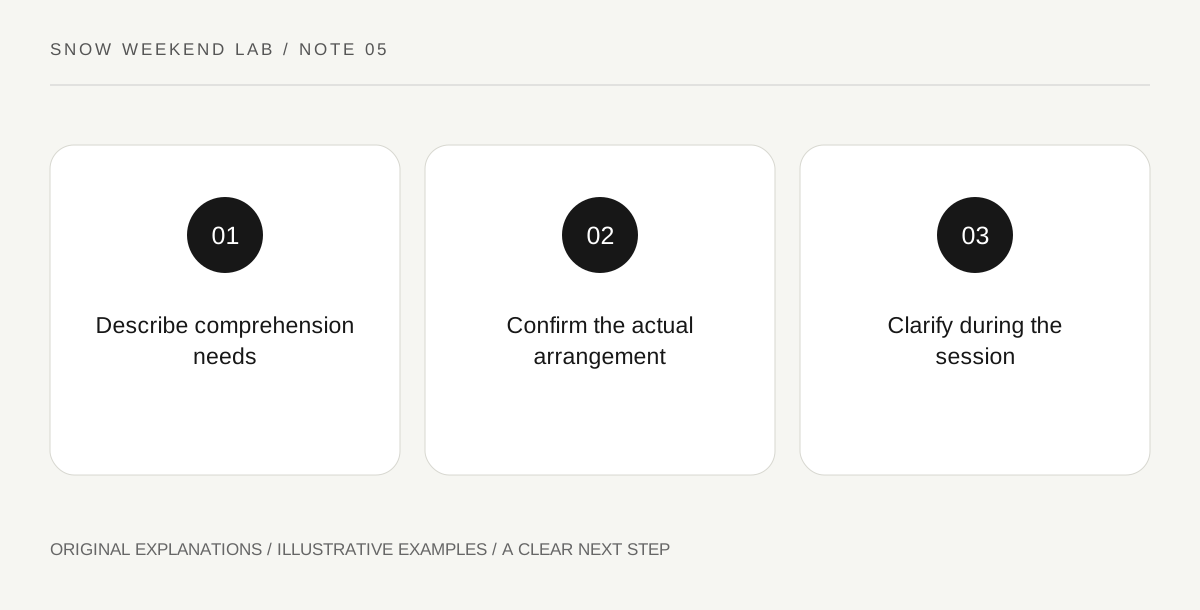
Original explanatory diagram. Read the full method and limitations below.
Describe comprehension rather than a nationality
Whistler Blackcomb’s official snow-school introduction discusses instructors supporting different languages, abilities and styles. That is a reason to ask a specific question, not a promise that every language is available on every date. Write the language in which the participant understands spoken instruction best and identify any relevant limitation. Nationality, passport and a few conversational phrases do not establish the same thing. A service inquiry becomes clearer when it describes what the participant needs to understand, rather than asking the provider to infer language from a booking address.
Ask what is requested and what is confirmed
A preference field may record a wish while a direct reply confirms an arrangement. Keep those two states separate in the trip record. Ask whether the school can confirm the requested language for the actual product, date and participant. If it cannot, discuss the offered alternatives before purchase or before the relevant change deadline. Do not silently assume that a multilingual website means instruction is available in every displayed language. The booking should leave the participant knowing which communication arrangement is actually in place.
Make clarification part of the first conversation
At the meeting point, tell the instructor if a spoken explanation is not clear. Ask for clarification within the lesson rather than pretending to understand to avoid embarrassment. Do not continue a task on the basis of a guessed translation. A companion’s help may be useful in an agreed role, but it should not be assumed acceptable or sufficient without the provider’s involvement. Keep translation tools away from active skiing or lift handling; any communication plan needs to work through the actual instructor and resort procedures.
Use the result to improve later bookings
After the session, note which communication arrangement worked and what would need to be confirmed differently next time. Focus on service details rather than evaluating the participant’s language ability as a personal failing. A clear request can include a need for slower explanation, visual demonstration or another format if the provider can support it. Finish with the wording you would reuse in a future inquiry. That practical sentence is more valuable than a broad claim that everyone should be able to manage in one common language.
Illustrative planning example
Illustrative inquiry: an adult can read a booking website in English but understands spoken instruction more comfortably in another language. They ask the school whether that language is confirmed for the specific session and receive a written answer. At check-in they repeat the arrangement and raise any comprehension problem directly. Their companion does not assume that occasional translation makes an unconfirmed lesson format equivalent.
Questions that come up
Does a website language guarantee a lesson in that language?
No. Website presentation and instructor availability are different services. Obtain an answer for the actual booking.
Can a bilingual friend replace the requested instructor language?
Only discuss such an arrangement with the provider. A companion’s presence does not automatically establish an appropriate or authorized teaching communication plan.
References and scope
These sources support the factual background. Examples and exercises are original illustrative teaching material. References do not imply endorsement.
- Whistler Blackcomb: Get the Goods, snow-school introduction — The provider’s general discussion of instructional language options; no date-specific availability guarantee.