Uphill access: treat it as a separate permission question
Seeing ski tracks on a resort slope does not establish permission to walk or skin uphill there. Some operators publish specific uphill programs with their own status and limits. For a recreational visitor, the first useful decision is whether the proposed activity is authorized at all, before considering equipment, fitness or a route seen in somebody else’s photograph.
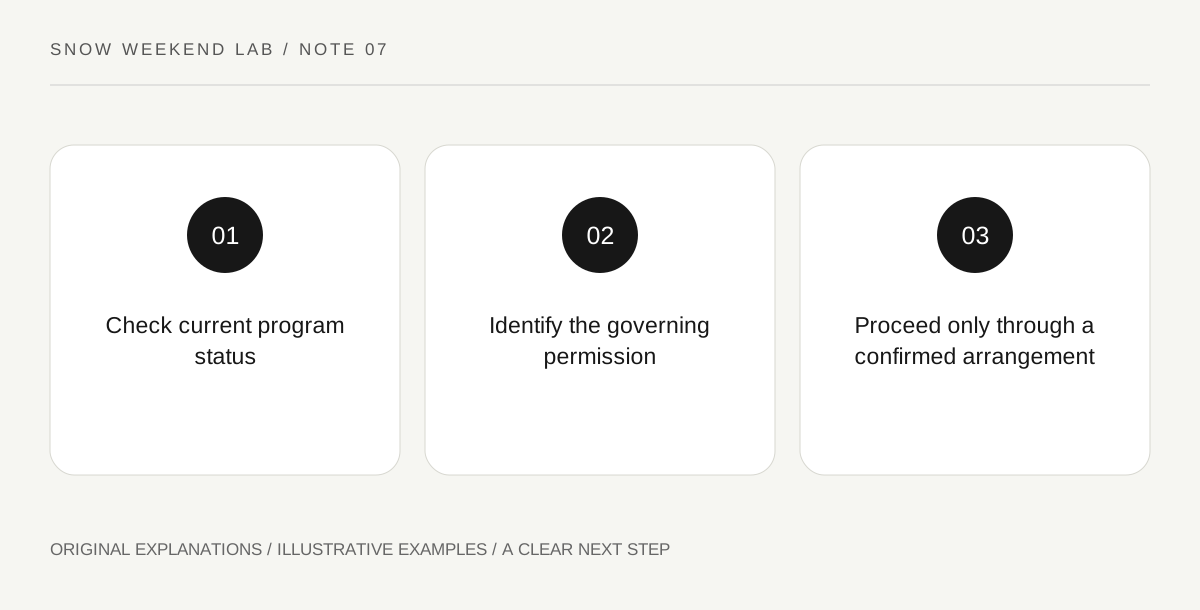
Original explanatory diagram. Read the full method and limitations below.
Read the current status before the general description
Park City’s official uphill policy publishes a status statement alongside general program information. The page illustrates why a descriptive paragraph about an activity must not override a closure notice. Read the current operator status for the actual date and identify which information applies now. This guide supplies no uphill itinerary or technique. A familiar resort name, a daytime lift pass or a general reference to public land does not answer the separate operational permission question for the activity you are considering.
Keep three permissions distinct
On a planning card, separate ordinary downhill access, any operator-authorized uphill program and travel beyond resort boundaries. Do not connect them with an assumed equals sign. Ask staff which policy governs the proposed activity and whether it is currently available. A provider’s answer may simply be that the activity is closed or outside its offered service. That is a complete answer to the permission question. Equipment ownership or experience from another mountain does not create an exception to the actual operator’s restrictions.
Do not treat quiet hours as unused terrain
A slope that appears empty can still be an active work environment. The operator’s policy discusses maintenance and other operations outside ordinary public use. You do not need to investigate those hazards personally to respect the restriction. Avoid approaching machinery, entering a closure or following another person as evidence that access must be permitted. If the plan depends on an available supervised activity, ask the responsible provider for an appropriate alternative rather than improvising a different way onto the same slope.
Close the planning loop honestly
Write the result in one of three states: confirmed operator-authorized arrangement, unresolved inquiry or not proceeding. Do not leave a closed or unconfirmed activity on the itinerary as though it were merely a weather-dependent option. This small record helps companions understand the decision without turning it into a debate about determination. A winter trip has many ways to be worthwhile, and abandoning an unauthorized proposal does not require replacing it with another mountain objective. The useful outcome is a plan that reflects the permission actually obtained.
Illustrative planning example
Illustrative card: a traveler sees an old uphill description but the current operator page states that access is closed. They mark the proposal not proceeding and remove it from the shared itinerary. A later question goes to the official provider about available staffed activities. Nobody treats a purchased downhill pass or another visitor’s tracks as authorization to enter the closed program.
Questions that come up
Does owning skins or snowshoes grant uphill access?
No. Equipment ownership does not answer the operator’s current permission question. Use the actual policy and staff directions.
Can I follow another uphill traveler as proof the route is allowed?
No. Another person’s presence does not establish permission or current conditions. Obtain authoritative information rather than copying an observed action.
References and scope
These sources support the factual background. Examples and exercises are original illustrative teaching material. References do not imply endorsement.
- Park City Mountain: Uphill Access Policy — The separate uphill program, changing status and operational restrictions; no route, technique or access guarantee.