Buying ski access for someone else: separate purchaser and participant records
A parent, partner or trip organizer may pay for a booking without being the person who uses it. Keep those roles separate when purchasing ski access or related services. A compact participant record helps identify mistakes before arrival, while leaving identity correction and transfer questions to the operator rather than treating a receipt as permission to swap users.
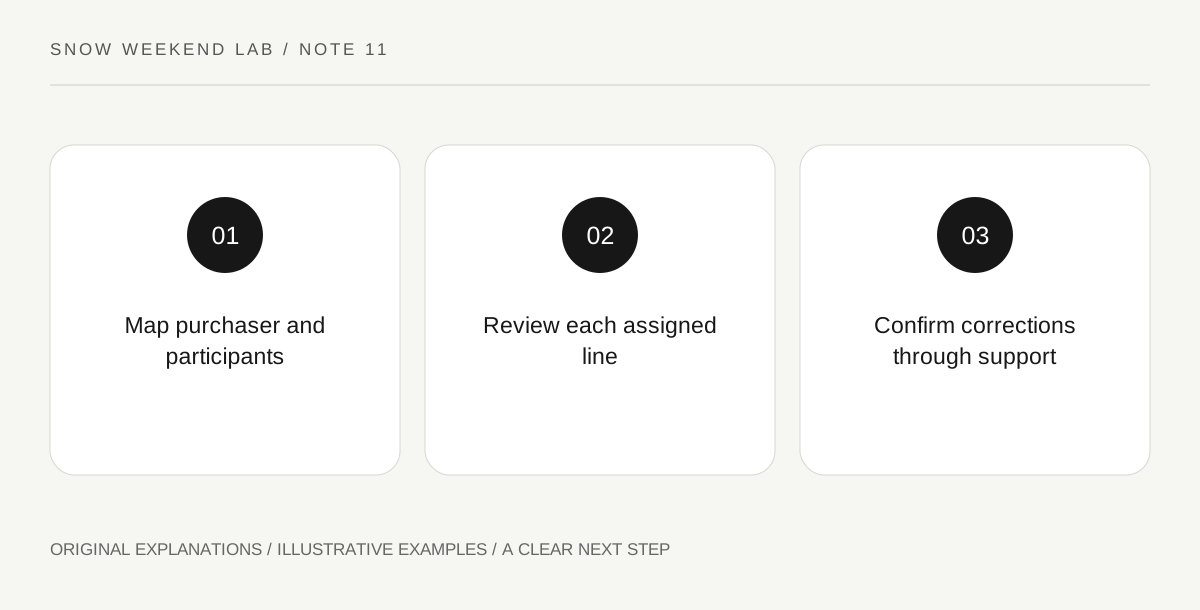
Original explanatory diagram. Read the full method and limitations below.
Give each person a named row
Epic’s official product terms distinguish individually assigned, non-transferable access products from the act of purchasing them. Use the exact terms for your product, but begin the worksheet with a simple distinction: who pays and who participates. A shared email address or card payment does not automatically identify the intended user of every line item. Write the participant’s name beside the actual product and date in a private trip record. Do not rely on the sequence in which family members happened to be entered into a shopping basket.
Review the assignment rather than only the total
A final total can be correct while an individual product is assigned incorrectly. Review each person’s entry, age category where relevant and intended service. Compare those details with the confirmation through the operator’s normal account process. This is an accuracy check, not a request to publish full personal records in a group spreadsheet. Keep only the minimum practical information needed by the organizer, and give each adult a chance to verify their own entry instead of asking them to trust a screenshot of a group total.
Describe an error before trying to repair it
If something is wrong, contact the operator with the booking reference and a clear description of the mismatch. Ask which correction process applies. Do not create a second account, exchange credentials or assume that editing a display name changes the assigned participant lawfully and completely. The source’s non-transferability language is a reason to use official support, not to invent an informal workaround. A correction request should preserve the difference between a clerical error and a proposed change of user, because the operator may treat them differently.
Close the record with confirmation
Keep the operator’s response and updated confirmation together, then recheck the relevant line rather than assuming that a support conversation finished every linked service. A pass, lesson and rental may sit in different records even when paid for at once. End with a short status for each participant: correct, awaiting support or unresolved. That makes the day’s readiness visible and prevents the person at check-in from inheriting a mystery about who a product belongs to. The goal is an accurate assigned booking, not merely a successful payment.
Illustrative planning example
Illustrative review: an organizer pays for two adults and notices that both service lines appear under the purchaser’s profile. They do not exchange credentials at the resort. Instead, they ask support whether the records reflect a display issue or an assignment error, follow the official correction route and retain the updated response. The group’s payment total remains separate from the question of who is entitled to use each service.
Questions that come up
Does paying for the booking make every product transferable within the group?
No. Read the exact product terms. The act of payment does not erase the operator’s assignment and transfer rules.
Does a changed screen label prove all linked records are corrected?
Not necessarily. Confirm the relevant participant and service information through the operator and recheck any separate records involved.
References and scope
These sources support the factual background. Examples and exercises are original illustrative teaching material. References do not imply endorsement.
- Epic Pass: Policies, Terms and Conditions — Individually assigned non-transferable access terms; original purchaser-versus-participant record method, not legal advice.