A ski snow report: keep accumulation periods and operating status in different fields
A large snowfall number can dominate attention while answering a much narrower question than whether your planned activity is operating. Read the report’s labels, measurement interval and update time before using the figure. A simple field card keeps snow observations, forecasts and current service status from collapsing into one encouraging but unsupported conclusion.
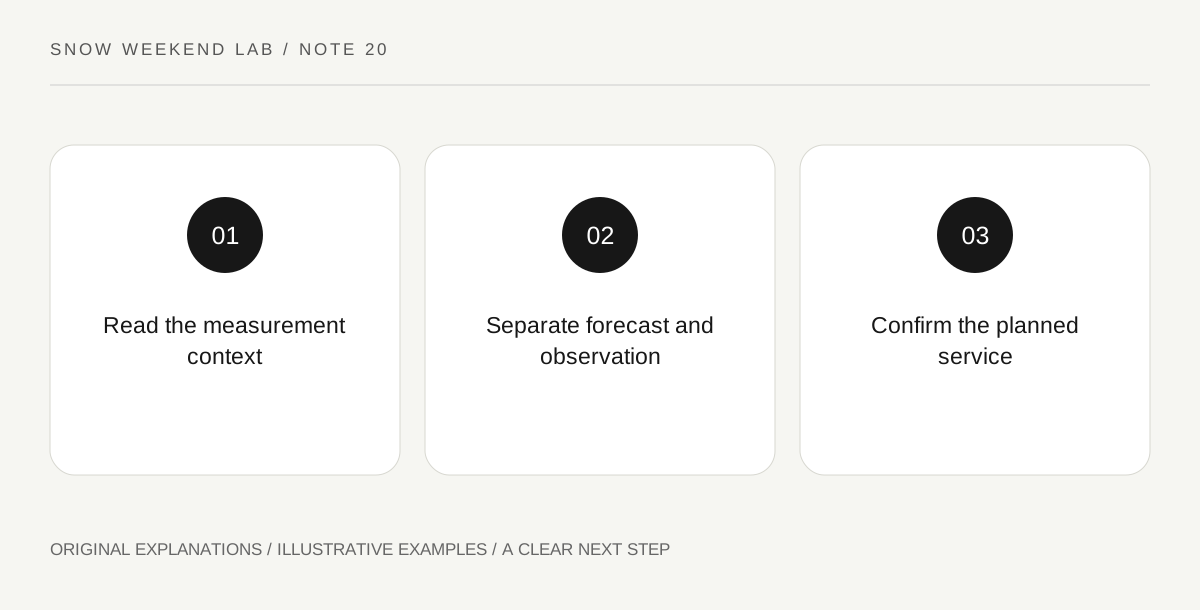
Original explanatory diagram. Read the full method and limitations below.
Copy the label with the number
Whistler Blackcomb publishes weather and snow information separately from detailed lift and terrain status. Use that separation as the starting point. When recording a figure, include its exact label, unit, location if stated and time interval. A cumulative seasonal amount, a recent accumulation and a depth measurement are different kinds of information. Do not remove the label and compare only the largest number. The report should retain enough context that another person can tell what the figure actually describes.
Keep observation and forecast distinct
Mark whether a statement concerns a reported measurement, a forecast or an operating update. A forecast is not a completed observation, and a reported amount does not establish what every part of a mountain feels like. If the report states a measurement location, preserve it rather than extending the figure across every elevation. This article does not teach terrain selection or snow-hazard assessment. Its narrow purpose is reading information accurately so the next question goes to the responsible provider with the right context.
Match the report to the planned service
After understanding the snow field, check the actual activity status and contact the provider if the booking question remains unresolved. A lesson, a sightseeing lift and a particular terrain area can have different operating information. Do not infer availability from a favorable snowfall headline or assume that an old cached image is current. Read the update time and any present notice. If information conflicts, ask staff rather than choosing the most optimistic item. The actionable plan depends on the service you intend to use, not on a general impression of winter conditions.
Write a modest conclusion
Finish with a sentence such as the report describes a stated accumulation period, while the lesson’s operation remains to be confirmed. Replace that sentence when the provider supplies the relevant answer. The conclusion may be less exciting than a social-media headline, but it is much more useful for a real booking. Keep the field card small enough to use once and update when necessary. It is not a forecast of personal enjoyment, a guarantee of suitable terrain or a reason to ignore signs and qualified assessment on the day.
Illustrative planning example
Illustrative field card: a traveler sees two snow figures, one for a short recent interval and another for a broader total. They retain both labels instead of comparing them as equivalent depths. A separate row holds the operator’s current lesson and lift information. The group’s decision waits for the relevant service answer rather than treating the larger figure as proof that every planned activity will operate.
Questions that come up
Does a large snowfall total prove every lift is open?
No. Snow information and operating status answer different questions. Use the operator’s current service information and staff guidance.
Can figures with different time periods be compared directly?
Only after preserving what each measures. A seasonal accumulation, recent amount and depth are not interchangeable fields merely because all use snow units.
References and scope
These sources support the factual background. Examples and exercises are original illustrative teaching material. References do not imply endorsement.
- Whistler Blackcomb: Snow and Weather Report — The operator’s labeled snow/weather reporting context, with separate lift/terrain status; no condition or terrain-suitability guarantee.