A missing ski pass: keep recovery, reporting and replacement separate
Losing a pass creates several different tasks: checking a plausible lost-property route, notifying the operator and establishing its accepted replacement process. Keep those tasks distinct so searching does not become an excuse to delay a required report or improvise access. A calm record helps guest services answer the actual problem without exposing account details publicly.
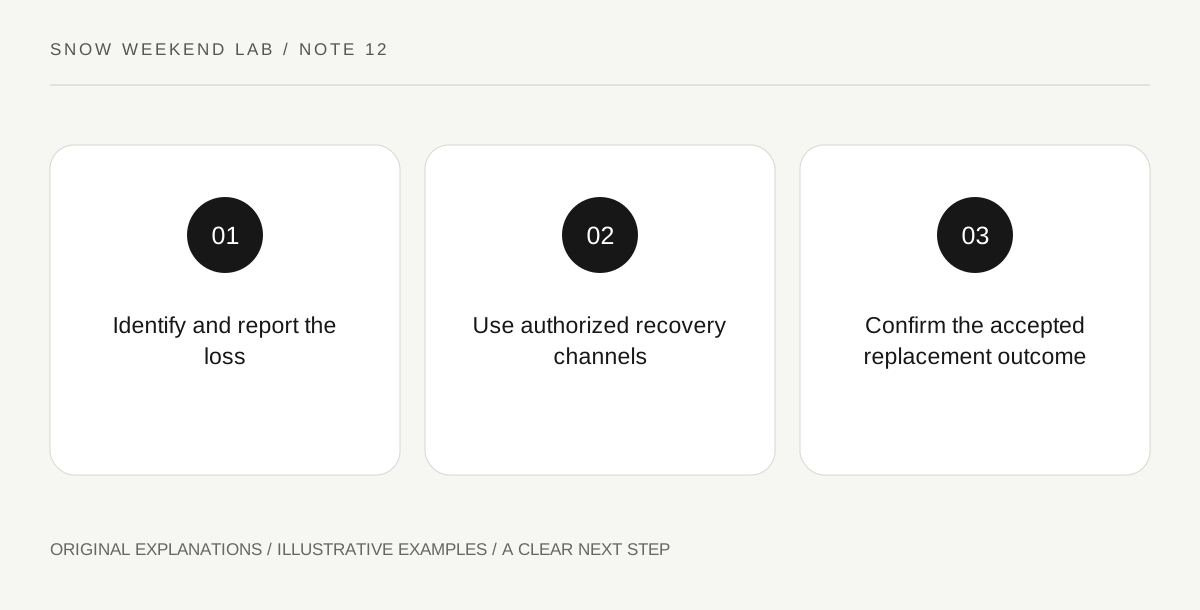
Original explanatory diagram. Read the full method and limitations below.
Identify what is missing
Epic’s current terms address lost or stolen passes, while Whistler Blackcomb publishes guest-services and lost-property routes. Start by naming the missing object: a physical card, a phone carrying a credential or another item. The steps may differ, so avoid reporting only that the ticket is gone. Keep the purchased product and participant identifiable through the operator’s requested private process. This article supplies no universal replacement fee or entitlement; the actual product and location determine what support can offer.
Report through the responsible service
Use the operator’s official contact or staffed desk and follow its current reporting instructions. If theft is suspected, ask which further reporting steps apply rather than making a public accusation about another visitor. Do not post a pass image, account number or identifying document in an open search message. A short factual account is enough to begin: what is missing, when it was last known to be present and which operator-managed product is involved. Let staff request any necessary verification through their proper channel.
Search without disrupting resort operations
Use the official lost-property process for a plausible recovery and provide a useful item description. Do not enter closed areas, return onto terrain without authorized access or disturb staff operations to retrace a path. If a companion helps search, agree where they will look and how they will contact you. The search is separate from replacement and from any operator instruction about securing the missing credential. That separation prevents one person from treating a possible future recovery as a reason to ignore the current access problem.
Confirm the result before rejoining the day
If a replacement or another supported arrangement is issued, ask what happens to the old credential and keep the response. Do not assume both remain usable or that finding the original restores it automatically. Reconnect with companions using the practical plan actually available, which may mean a later start or staying at the base. Finish with a private record of the report and outcome. A documented resolution is more useful than repeated attempts at a gate with an unverified screenshot or a borrowed card.
Illustrative planning example
Illustrative resolution: a traveler realizes a physical card is missing near the base. They report it through guest services, provide verification privately and submit a separate lost-property description. A companion checks one authorized public location. When the operator supplies its accepted resolution, the traveler asks what to do if the old card appears later, avoiding an assumption that two credentials can be used interchangeably.
Questions that come up
Can I borrow a friend’s pass while support investigates?
Do not assume that is permitted. Follow the product’s transfer rules and the operator’s accepted support process.
Does finding the original card automatically make it active again?
That depends on the operator’s action. Ask before using it, particularly if it was reported or replaced.
References and scope
These sources support the factual background. Examples and exercises are original illustrative teaching material. References do not imply endorsement.
- Whistler Blackcomb: Guest Services — The official guest-services and lost-property route; replacement obligations and conditions require the actual product’s terms.