A ski booking deadline: put the operator’s clock beside your own
A cancellation rule can be understood in words yet still be misread on a travel day because of time zones, start times or separate products. Turn the actual rule into a dated private reminder, retaining the operator’s wording and confirmation route. The worksheet helps you ask an accurate question; it does not invent refund rights or replace the booking terms.
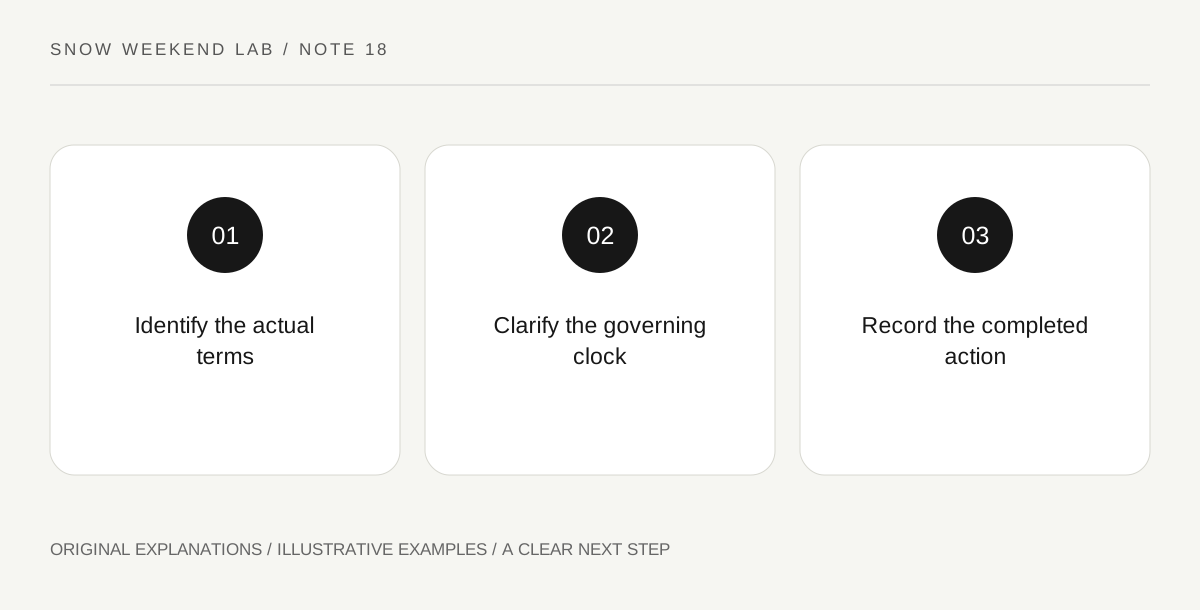
Original explanatory diagram. Read the full method and limitations below.
Identify the relevant product first
Whistler Blackcomb publishes different policies for lessons and rentals, including their own change and cancellation processes. That is enough to show why one deadline should not be copied across every line of a trip. Write the exact product, provider and scheduled start before reading the rule. A lift-access product, a lesson and a rental may have different terms even when paid for together. Use the terms applying to the actual booking and preserve any product-specific exception stated by the provider.
Translate the rule into an explicit clock question
If the rule is expressed as a number of hours before a start, identify the start time and its time zone. Ask the operator which clock governs if the wording is unclear. Write the proposed calculated deadline beside the original rule and label it awaiting confirmation until uncertainty is resolved. Do not assume the device’s calendar has retained the intended zone after travel. The exercise concerns accurate scheduling, not finding a technical loophole or treating a personal interpretation as a binding promise from the provider.
Use a fictional example to test the arithmetic
For an illustrative exercise only, imagine a service beginning at noon on a Saturday and a fictional rule requiring action two days earlier at the same local time. The worksheet would show Thursday noon in the service’s local zone, then the traveler’s equivalent reminder separately. Those invented terms do not describe any resort policy. The example demonstrates why local deadline, home reminder and actual submission route belong in different fields. If daylight-saving or another time ambiguity matters, ask for an explicit dated answer rather than relying on mental conversion.
Record action and outcome separately
A reminder tells you when to act; it does not establish that a change request was submitted or accepted. Use the provider’s specified channel, retain the actual confirmation and check any remaining linked products. If the operator changes or cancels a service, ask which terms and next steps apply to that event rather than assuming they match a participant-initiated cancellation. End with a status such as unchanged, request submitted or confirmed changed. A clear record helps avoid mistaking an unsent intention for a completed booking action.
Illustrative planning example
Illustrative worksheet: a traveler lists a lesson and rental separately because their published rules differ. They retain each original policy link and ask the provider to clarify an ambiguous local deadline. A private calendar reminder is then created, but the booking remains unchanged until the specified request is actually submitted and confirmed. The worksheet never promises a refund based solely on the traveler’s calculation.
Questions that come up
Does a calendar reminder cancel a reservation?
No. It is only a prompt. Follow the provider’s actual process and retain its confirmation of the outcome.
Do these fictional example terms create a refund entitlement?
No. The example teaches scheduling structure. Only the actual booking terms and provider response can address the particular transaction.
References and scope
These sources support the factual background. Examples and exercises are original illustrative teaching material. References do not imply endorsement.
- Whistler Blackcomb: Ski School Preparation and policies — The existence of product-specific change/cancellation processes; no copied deadline, legal interpretation or refund guarantee.