A birthday during a ski holiday: ask how the lesson category is assigned
An age boundary can affect which lesson product a provider offers even when a family thinks of the holiday as one continuous week. If a participant has a birthday near the trip, ask which date the school uses for its category and which practical arrangements follow. Keep the answer product-specific rather than inventing a universal rule for every resort.
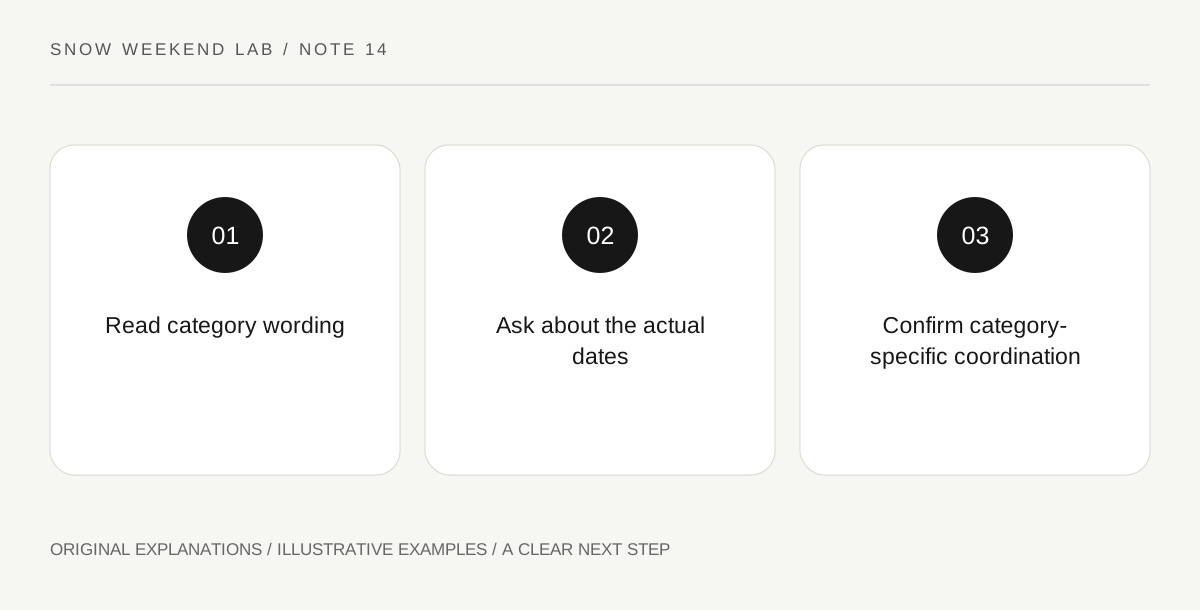
Original explanatory diagram. Read the full method and limitations below.
Identify the product’s actual age language
Whistler Blackcomb separates child, teen and adult lesson products. That illustrates why a participant’s age may be more than a descriptive field in a booking. Read the exact category wording and any eligibility instructions for the product you are considering. Do not assume that an airline’s age rule, a school-year label or another resort’s policy applies. The useful first question is how this provider determines the relevant age for this service, especially when the birthday and travel dates fall close together.
Ask with real dates through a private route
Provide the dates the school requests through its normal booking or support process and ask for the category applying to the actual session. You do not need to publish the participant’s full birth date in a group itinerary. If the answer differs across dates, ask how the provider wants the sequence booked. Keep the response with the relevant confirmation. This is an eligibility and service inquiry, not a request to alter a birth date so that a preferred price or grouping appears available.
Check what the category changes in practice
A different product may have another meeting point, end-of-session arrangement or participant expectation. Read the confirmation for the actual category rather than assuming only the price changes. Ask the school to clarify who is responsible at check-in and completion, and organize the family’s coordination accordingly. Do not borrow another product’s handover instructions because the names look similar. The practical effect of a category matters most when it changes who needs to be where and what the provider expects from the participant or accompanying adult.
Keep family preferences distinct from eligibility
Siblings or friends may hope to remain together, but the provider must decide what its actual product allows. Ask about available arrangements without pressuring a participant to misstate age or ability. If the group is divided, create a reunion plan suited to the confirmed services. End the record with the school’s category answer, the actual booked product and its coordination instructions. The birthday then becomes a resolved detail in the plan rather than an unexpected discussion at check-in when the family has already made conflicting assumptions.
Illustrative planning example
Illustrative inquiry: a participant’s birthday falls between two proposed lesson dates. The family asks the school privately which category and arrangements apply on each date. The reply is saved with the bookings, and the family revises the meeting plan because the confirmed products have different completion procedures. Nobody assumes that one week-long holiday automatically fixes the same product category for every provider.
Questions that come up
Is age always measured on the first day of a holiday?
No universal rule is established. Ask the provider which date and eligibility process apply to the actual product.
Can friends remain together simply by choosing one age category?
The provider’s eligibility and grouping rules govern the booking. Ask about legitimate options instead of changing participant information to force a grouping.
References and scope
These sources support the factual background. Examples and exercises are original illustrative teaching material. References do not imply endorsement.
- Whistler Blackcomb: Ski & Snowboard Lessons — The existence of child, teen and adult lesson products; the article asks rather than invents birthday-assignment rules.