A race or rail-jam day: separate watching the event from skiing the resort
A resort event can sit inside a wider operating day without giving spectators and skiers the same access. Before planning a visit around a race or rail jam, identify what you want to watch and how the organizer expects spectators to reach it. Keep that arrangement separate from your own skiing plans and any participant-only area.
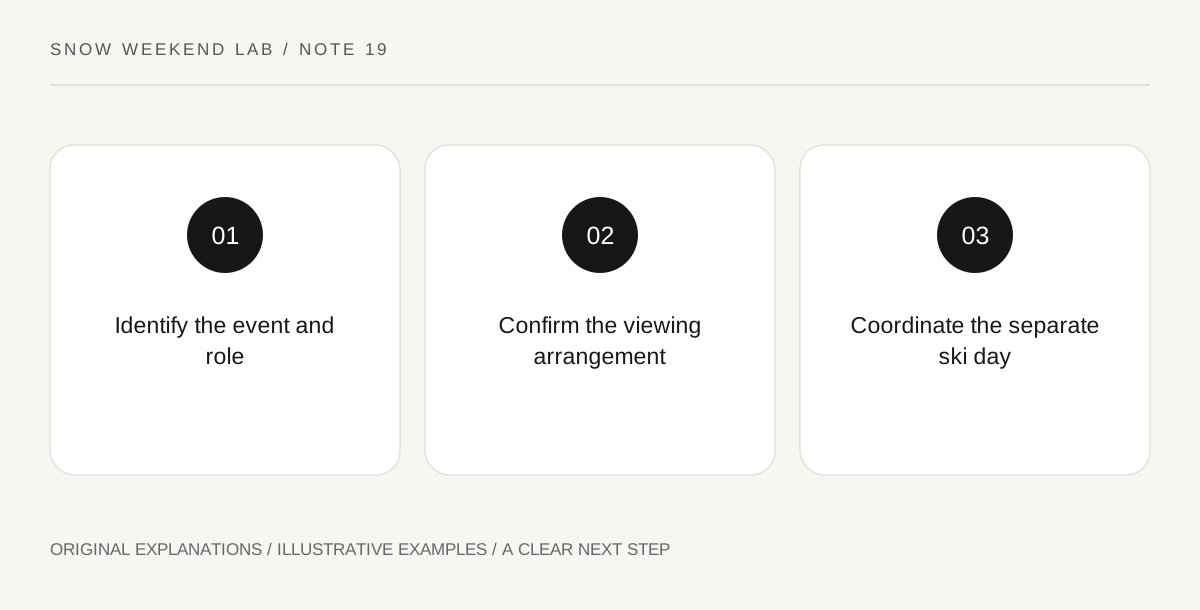
Original explanatory diagram. Read the full method and limitations below.
Read the actual event entry
Brighton’s official events page distinguishes organized happenings from the resort’s general winter offer. Use the current entry for the exact event and date you are considering. A social-media image or an old result does not establish this year’s spectator access. Identify the event organizer, location and stated audience. If the entry does not explain how non-participants attend, ask that question before treating the event as a simple extra stop on an ordinary ski-day itinerary.
Separate three roles on the plan
Write spectator, event participant and recreational skier as distinct roles. One person may occupy more than one at different times, but the permissions do not automatically merge. A competitor registration does not explain a companion’s access, and a lift pass does not authorize entry into a competition area. Ask which ticket, accreditation or permitted public route applies to the role you actually intend. Keep the answer attached to that role rather than using the broad phrase we are going to the event.
Let the organizer define the viewing area
Use the organizer’s authorized spectator arrangement and follow current signs and staff directions. Do not cross barriers, stand in a competitor route or seek a better camera angle through an access restriction. This article does not supply a route onto snow for foot passengers or a terrain assessment. If an event is visible only through an arrangement unsuitable for your group, choose another way to follow it or another activity. A clear boundary is part of a workable visit, not an obstacle to be creatively bypassed.
Keep the rest of the day flexible
An event may affect where and when the group meets, but do not infer a whole-resort closure or a universal crowd forecast from its existence. Read current operator information for the services you actually need. Protect any lesson or return obligation as a separate appointment. Finish with a short card stating the event, your role, the confirmed access and a reunion point. The plan remains useful even if the event changes because each dependent arrangement is visible rather than hidden inside an overfull ski itinerary.
Illustrative planning example
Illustrative card: two adults want to watch a named resort event, while a friend hopes to ski independently. They ask the organizer about authorized spectator access and keep the friend’s lift-access plan separate. The reunion point is chosen from confirmed permitted facilities. A participant-only area stays outside the plan, and no one treats the event listing as permission to walk onto a competition slope.
Questions that come up
Does an event listing mean spectators can enter every area free of charge?
No. Admission, access and accreditation need the event’s actual information. Ask when the public arrangement is not stated.
Does a lift pass automatically authorize competition-area access?
No such permission is established. The event organizer and resort control their relevant access arrangements and restrictions.
References and scope
These sources support the factual background. Examples and exercises are original illustrative teaching material. References do not imply endorsement.
- Brighton Resort: Events — The operator’s separate event listings; no event-specific date, admission or spectator-route promise.